
1. Executive Summary & Industry Imperatives in HPHT Environments
The global energy landscape demands components capable of withstanding unprecedented mechanical loads, severe corrosive media, and extreme thermal gradients. In modern High-Pressure High-Temperature (HPHT) subterranean and subsea installations, operating conditions routinely exceed 20,000 PSI (138 MPa) operating pressure and temperatures over 200°C (392°F). Under these hostile conditions, field failure of a single wellhead valve, blowout preventer (BOP) stack, or fluid end manifold can lead to catastrophic environmental contamination and millions of dollars per day in non-productive time (NPT).
Consequently, the manufacturing of oilfield components has evolved from conventional machining to highly specialized, high-rigidity metal cutting engineering. Oil and gas CNC machining is no longer merely a matter of metal removal; it is the science of controlling micro-structural stress, ensuring precise geometric tolerances (GD&T), achieving mirror-like surface finishes (Ra < 0.4 µm) on metal-to-metal seal pockets, and maintaining strict compliance with NACE MR0175/ISO 15156 and API Spec 6A Product Specification Levels (PSL 3 & PSL 4).
In traditional multi-machine oilfield valve manufacturing, shifting a 3-ton forged valve body between a Vertical Turning Lathe (VTL) and a 5-axis Horizontal Machining Center (HMC) introduces stack-up datum errors ranging from 0.03mm to 0.08mm. By consolidating turning, facing, boring, and milling into a single setup using an integrated U-axis contouring head, cumulative datum drift is completely eliminated, yielding true position tolerances under 0.005mm.
At Nanjing Fortis Storage Equipment Manufacturing Co., Ltd., our engineering division has analyzed the systemic bottlenecks facing B2B energy manufacturers. For over six decades, our heavy-duty CNC machining centers—equipped with patented integrated U-axis facing heads—have redefined productivity across major global oilfield OEMs. This white paper serves as an authoritative technical reference for procurement directors, manufacturing engineers, and operations managers evaluating machine tool investments for high-spec oilfield applications.
2. Metallurgical Cutting Dynamics of Superalloys and Heavy Forgings
Oilfield components rely heavily on corrosion-resistant alloys (CRAs) and high-yield strength forged steels. Materials such as Inconel 718, Inconel 625, Duplex and Super Duplex Stainless Steels (e.g., UNS S32750), Hastelloy C276, and heat-treated 4130/4140 low-alloy steels provide exceptional yield strengths (up to 150 ksi) and pitting resistance equivalent numbers (PREN > 40). However, these metallurgical properties make them notoriously difficult to machine.
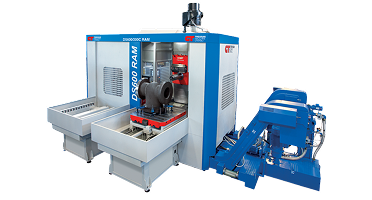
2.1 Physical Mechanics of Cutting High-Nickel and Duplex Steels
When cutting superalloys like Inconel 718, machine operators encounter four distinct mechanical challenges that degrade tool life and part accuracy:
- Extreme Thermal Concentration: Inconel 718 exhibits low thermal conductivity (approx. 11.4 W/m·K at room temperature, compared to 52 W/m·K for carbon steel). Over 80% of the cutting heat remains concentrated directly at the tool cutting edge, subjecting indexable carbide inserts to thermal stresses exceeding 1,000°C.
- Severe Work Hardening: Superalloys undergo rapid plastic deformation during shearing. The material layer directly underneath the cut hardens almost instantly. If the cutting tool dwells or experiences chatter, the insert nose cuts through work-hardened material, leading to notch wear and micro-chipping.
- High Dynamic Shearing Forces: The sheer yield strength of forged oilfield alloys generates enormous tangential cutting forces, requiring high mechanical torque at low RPMs rather than high-speed light cutting.
- Built-Up Edge (BUE) and Abrasion: Hard carbide particles within high-nickel matrices cause aggressive abrasive wear along the insert flank face, while sticky material adhesion leads to micro-welding and premature tool destruction.
| Material Grade | Tensile Strength (MPa) | Thermal Conductivity | Machinability Index (%) | Primary Failure Mode |
|---|---|---|---|---|
| 4130 / 4140 Alloy Steel | 750 - 950 | 42.6 W/m·K | 65% | Flank Wear |
| Duplex 2205 (UNS S31803) | 680 - 880 | 19.0 W/m·K | 40% | Work Hardening & BUE |
| Super Duplex 2507 | 750 - 1000 | 15.0 W/m·K | 25% | Notch Wear & Thermal Fatigue |
| Inconel 718 (UNS N07718) | 1100 - 1400 | 11.4 W/m·K | 12 - 15% | Rapid Flank / Crater Wear |
Overcoming these severe metallurgical constraints requires a CNC machining platform designed with immense mass, superior damping characteristics, high-torque geared spindles, and rigid tool support. Machines engineered by Nanjing Fortis Storage Equipment Manufacturing Co., Ltd. incorporate heavy cast-iron beds (Meehanite casting) with induction-hardened box ways, suppressing harmonic vibrations and doubling tool insert life during heavy alloy roughing.
3. Kinematic Innovation: Stationary Part Machining vs. Rotational VTL Systems
One of the most critical decisions in B2B procurement for oil and gas CNC machining is selecting the core machine kinematics. Historically, manufacturers relied on large Vertical Turning Lathes (VTLs) or Horizontal Boring Mills (HBMs) to handle large valve bodies, blowout preventers, and tree blocks.
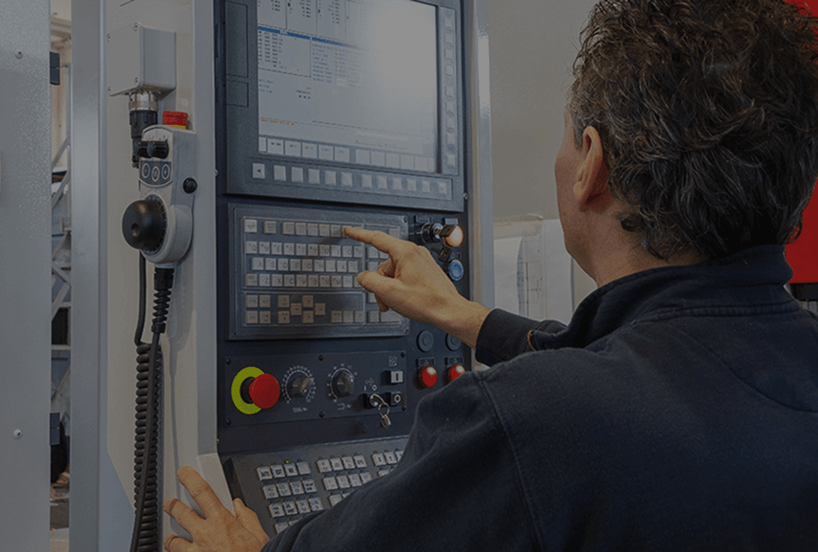
3.1 The Dynamics of Rotating Heavy Asymmetrical Forgings
When machining an API 6A gate valve body or a multi-flanged cross valve on a conventional VTL, the entire workpiece—weighing anywhere from 500 kg to over 10,000 kg—must be rotated at high angular velocities to achieve required surface cutting speeds ($V_c$). This approach presents severe inherent physical flaws:
- Asymmetrical Mass Imbalance & Centrifugal Force: Valve forgings feature side outlets, bonnet flanges, and irregular outer geometries. Rotating an off-center mass generates massive centrifugal forces ($F_c = m \cdot \omega^2 \cdot r$), resulting in spindle runout, dynamic table wobbling, and safety risks.
- Excessive Power Dissipation: Accelerating and decelerating a 5-ton workpiece to 400 RPM consumes immense electrical energy and increases cycle times due to inertia.
- Complex Fixtures and Setup Distortion: Clamping irregular shapes on a spinning chuck requires customized counterweights and high clamping forces, often causing elastic deformation of the valve body that distorts final seat tolerances upon unclamping.
3.2 The Stationary Part Solution: Rotating the Tool, Not the Part
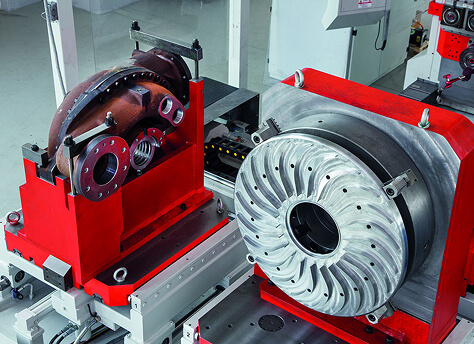
The engineering philosophy of Nanjing Fortis Storage Equipment Manufacturing Co., Ltd. flips this paradigm. By clamping the heavy workpiece securely to a high-rigidity hydraulic rotary table, the part remains completely stationary throughout the machining operation.
Instead of spinning the part, turning operations—such as facing, taper boring, external turning, and API ring groove contouring—are performed by a dynamically controllable, rotating facing head equipped with a programmable U-axis slide. This kinematic setup delivers key operational advantages:
- Zero Centrifugal Distortion: Because the heavy workpiece does not spin, off-center mass is irrelevant. Cutting speeds are maintained by rotating the balanced tool slide.
- Standardized Modular Workholding: Simple tombstones or hydraulic vices replace complex counterweighted chucks, reducing setup time by up to 70%.
- Multi-Angle Machining in One Setup: The precision B-axis rotary table rotates the stationary workpiece precisely 90°, 180°, or 270°, allowing all valve faces, side bores, and flange bolt patterns to be machined in a single setup.
4. Dual-Spindle & Integrated U-Axis Facing Head Architecture
To eliminate the trade-off between heavy milling and high-precision turning, the engineering team at Nanjing Fortis developed a dual-spindle headstock design integrated directly into our horizontal machining centers.
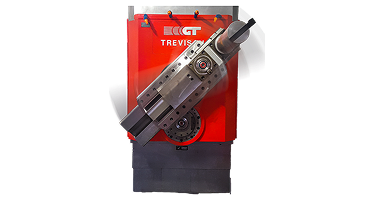
4.1 Mechanical Mechanics of the Integrated Facing Head
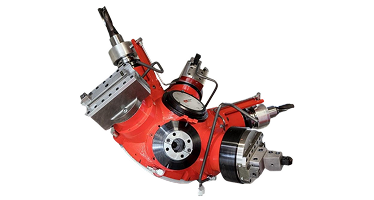
Unlike secondary attachable facing heads—which suffer from thermal expansion, reduced stiffness, and manual mounting overhead—the Nanjing Fortis Integrated Facing Head is built permanently inside the machine spindle housing. The headstock contains two co-axial or parallel spindle channels:
Spindle 1: Milling & Drilling Quill
Designed for maximum material removal rates (MRR), featuring an ISO 50 / HSK-A100 taper, heavy quill extension, and high torque output up to 2,500+ Nm. Dedicated to heavy face milling, deep hole drilling, and rigid tapping.
Spindle 2: CNC Controlled U-Axis Slide
A fully integrated tool slide mounted on the rotating head body. Controlled dynamically as an independent CNC axis, allowing full 2D contouring, taper turning, threading, spherical machining, and internal recessing while the main head rotates.
The U-axis slide features an internal high-precision ground ball screw driven through a planetary differential gear system. This mechanical linkage allows real-time tool adjustment during full spindle rotation at speeds up to 800 RPM. Consequently, complex internal profiles—such as API 6A BX and R ring gasket grooves, valve seat pockets, and internal casing threads—can be machined with single-point lathe tools rather than costly specialized milling cutters.
5. Single-Setup vs. Multi-Machine Workflow Analysis
For B2B procurement decision-makers, evaluating oilfield CNC machining investments requires analyzing total manufacturing throughput. Below is a comparative operational matrix contrasting a traditional multi-machine production line against the unified Nanjing Fortis Horizontal U-Axis Machining Center workflow.
| Workflow Parameter | Traditional Line (VTL + HMC + Radial Drill) | Nanjing Fortis Integrated U-Axis Setup | Performance Gain |
|---|---|---|---|
| Required Machines | 3 Machines (VTL, 4-Axis HMC, Drilling Rig) | 1 Machine (Trevisan HMC with U-Axis) | 66% Floor Space Saved |
| Total Machine Setups | 4 to 6 Manual Re-clamping Operations | 1 Single Clamping Setup | 80% Setup Time Reduction |
| Cycle Time (4" API 10K Valve) | 8.5 Hours Total Operating Time | 2.8 Hours Total Operating Time | 67% Production Fast-Track |
| Concentricity / Alignment | 0.040 mm – 0.080 mm Stack Error | < 0.005 mm Absolute Datum Precision | 8X Tolerance Improvement |
| Direct Labor Requirement | 3 Skilled Operators Across Shifts | 1 Operator (Cell Automation Ready) | 66% Reduction in Labor Cost |
| Scrap & Re-work Rate | 3.5% (Datum shift during re-clamping) | < 0.2% (Eliminated re-alignment) | 94% Scrap Reduction |
By executing rough facing, flange turning, main bore boring, valve seat pocket turning, bonnet bolt pattern drilling, and thread milling in a single setup, manufacturing shops eliminate inter-machine transport time, reduce crane dependencies, and shorten production lead times from days to hours.
6. Deep-Dive Component Applications: Subsea Valves, Fluid Ends & Manifolds
To demonstrate practical capabilities, the following section details technical manufacturing procedures for three key oilfield components machined on systems from Nanjing Fortis Storage Equipment Manufacturing Co., Ltd.
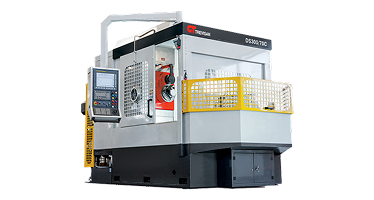
6.1 API Spec 6A Gate Valve Bodies & Christmas Tree Assemblies
API 6A gate valves require tight tolerances on metal-to-metal sealing surfaces. The gate pocket and seat recesses must maintain strict perpendicularity relative to the flow bore axis to prevent pressure leaks under high-pressure gas testing.
- Machining Sequence: The forged valve block is loaded onto the rotary table. The U-axis facing head faces the main inlet flange, turns the seal groove, and bores the internal cavity. The B-axis table then indexes 180° to machine the opposing outlet flange. Finally, the table indexes 90° to bore the bonnet cavity, turn internal threads, and drill side port holes.
- Key Tolerance Met: API ring gasket groove surface finish $R_a < 0.8 \ \mu\text{m}$, flange face flatness within $0.012\text{ mm}$, seat pocket true position within $\varnothing 0.010\text{ mm}$.
6.2 Frac Fluid Ends & Triplex / Quintuplex Mud Pump Cylinders
Fracturing fluid ends are subjected to extreme pressure cycling, high flow velocities, and highly abrasive proppant slurries. Machined from forged 4130 steel or 17-4PH stainless steel blocks weighing up to 8 tons, fluid ends feature complex internal intersecting bores.
Using the heavy-duty spindle quill on Nanjing Fortis machining centers, operators perform deep bore drilling and high-feed plunge milling of suction and discharge cavities at high material removal rates. The integrated U-axis slide then turns internal seal sealing threads and internal gland packing counterbores without requiring specialized long-reach boring bars.
6.3 Wellhead Tubing Heads, Casing Hangers & Subsea Connectors
Casing hangers and subsea tree mandrels require complex internal taper bores, locking grooves, and precision threads (e.g., API Buttress, Premium Thread Profiles). On conventional equipment, turning these internal tapers requires special form tools or complex multi-axis interpolation. The Nanjing Fortis U-axis contouring head paths single-point turning inserts along programmable CNC vectors, interpolating X, Z, and U axes simultaneously to cut any thread or taper profile with off-the-shelf indexable inserts.
7. GD&T Precision, API Spec 6A Compliance & Quality Verification
Meeting international quality certifications—such as API Spec 6A (PSL 3G / PSL 4), API Spec 16A (BOPs), and ISO 10423—requires strict adherence to Geometric Dimensioning and Tolerancing (GD&T) standards.
7.1 Key GD&T Parameters Achieved in Single-Setup U-Axis Machining
- Concentricity & Total Runout: Internal valve seat bores and outer flange seal faces maintain total radial runout under $0.008\text{ mm}$ because both features are cut in the same rotational cycle of the facing head.
- Perpendicularity of Flange Faces: The precision-ground B-axis rotary table uses a high-resolution absolute optical encoder, providing indexing accuracy within $\pm 2\text{ arc-seconds}$. Flange faces remain strictly perpendicular to internal flow bores.
- Surface Micro-Finish ($R_a$ and $R_z$): Single-point turning via the U-axis head avoids tool-step marks common in 3D thread milling, delivering consistent surface roughness values down to $R_a 0.4 \ \mu\text{m}$ ($16 \ \mu\text{in}$) on metal-to-metal sealing pockets.
8. B2B Procurement Evaluation: Calculating Total Cost of Ownership (TCO) & ROI
When procurement managers evaluate CNC machinery for oilfield component lines, assessing capital expenditure (CapEx) alone provides an incomplete picture. Capital investments must be measured against operational expenditure (OpEx), factory floor productivity, tool consumption, and scrap rates over a 10-to-15-year machine lifecycle.
Consider an oilfield valve manufacturer producing 5,000 units of 3-1/16" 15K Gate Valves annually. Transitioning from a 3-machine VTL/HMC line to a single-setup Nanjing Fortis U-axis center yields the following annual savings:
- Direct Labor Savings: 2 operators saved across 2 shifts = $180,000 / year
- Cycle Time Reduction: 5.7 hours saved per valve @ $95/hr shop rate = $2,707,500 / year
- Tooling Cost Savings: Replacing custom carbide form tools with indexable inserts = $65,000 / year
- Scrap Reduction: Eliminating multi-setup datum errors saves 150 forgings/yr = $135,000 / year
- Total Estimated Annual Value Returned: $3,087,500 (Achieving complete machine payback in under 14 months).
9. Strategic Partnership, Global Support & Technical Conclusion
In the energy sector, selecting a machinery supplier is a decades-long strategic partnership. Machine down-time directly impacts field delivery schedules and contract fulfillment for tier-1 oilfield services companies.
Nanjing Fortis Storage Equipment Manufacturing Co., Ltd. supports global energy equipment manufacturers through an integrated service model:
- Turnkey Process Engineering: Our applications engineering team conducts full time-study simulations, designs custom fixture workholding, develops optimized CNC toolpaths, and supplies complete turnkey tooling packages before machine shipment.
- Lifecycle Technical Support & Spares: We maintain extensive spare parts inventories, field service response teams, and factory-trained technicians to support machine installations worldwide.
- Operator Training & Process Optimization: Comprehensive on-site training ensures your shop floor team masters programming the U-axis facing head, macro variables, and preventive maintenance protocols.
Ready to evaluate how stationary part machining and integrated U-axis facing head technology can transform your shop's valve, fluid end, or wellhead production line?
Contact our technical engineering team directly at [email protected] or explore our machine portfolio online to request a detailed time study and proposal.