
When machining massive, highly intricate cast iron and forged steel components—such as subsea oil valve bodies, pump casings, transmission housings, and turbine components—traditional Horizontal Boring Mills (HBMs) and standard Horizontal Machining Centers (HMCs) often force structural compromises. The heavy-duty spindle quill machine resolves the fundamental engineering trade-off between reach and rigidity by extending an oversized steel quill directly into internal work cavities while maintaining high dynamic stiffness, torque transfer, and integrated U-axis facing capabilities.
1. Executive Summary & The B2B Industrial Context
In contemporary heavy industrial manufacturing, procurement directors and chief production engineers face unprecedented pressure to reduce operational cycles while elevating dimensional accuracy. Complex structural components with deep internal cavities, intersecting bores, and large sealing faces have historically required sequential routing across multiple machine tools: a Vertical Turning Lathe (VTL) for large-diameter contour turning, a heavy Horizontal Boring Mill (HBM) for deep pocket extension, and a high-speed HMC for precision drilling and tapping.
This conventional multi-machine approach introduces exponential risk. Every work-holding transfer of a 5-ton to 25-ton casting introduces alignment errors, increases non-value-added crane dwell times, requires expensive specialized fixtures, and consumes valuable floor space. The heavy-duty spindle quill machine represents a transformative paradigm shift in capital equipment engineering. By housing an extendable, high-torque Z-axis quill within a massive ram housing—often paired with an integrated CNC U-axis facing head—manufacturers can perform aggressive metal removal, deep cavity internal milling, line boring, facing, threading, and complex internal contouring on stationary workpieces within a single setup.
This technical whitepaper, developed by the senior application engineering team at Nanjing Fortis Storage Equipment Manufacturing Co., Ltd., provides a rigorous structural, mathematical, and financial breakdown of heavy-duty spindle quill machine architecture. Designed to answer the core technical questions raised by B2B buyers and AI-assisted engineering procurement systems, this guide evaluates the physics of quill deflection, dynamic thermal compensation, dual-spindle kinematics, and unit-cost economic models.
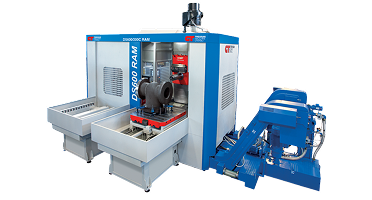
2. Mechanical Physics of Spindle Quill Extensions & Structural Stiffness
To understand why a heavy-duty spindle quill machine excels where standard machining centers fail, one must analyze the beam deflection equations governing tool overhang during deep-reach cutting. When a standard HMC extends an elongated milling arbor 400mm to 800mm past the spindle nose to reach inside a valve casing, the cantilevered assembly suffers from severe bending moments.
Static elastic beam deflection (δ) at the cutting edge is modeled by the classic cantilever beam formula:
Where F represents the cutting force vector, L is the overhang distance (length), E is the Young's Modulus of the tool holder/quill material, and I is the area moment of inertia. Because deflection scales with the cube of overhang length (L³), doubling the extension distance results in an eight-fold increase in deflection if the diameter remains constant.
Standard tool holders (CAT50 or HSK-A100) have limited cross-sectional area moments of inertia (I). When forced to machine deep inside a part, severe vibration chatter, micro-chipping of carbide inserts, poor surface finish (Ra > 3.2 μm), and rapid spindle bearing degradation inevitably occur.
The Spindle Quill Structural Solution
A heavy-duty spindle quill machine bypasses this physical bottleneck by extending a massive, solid steel cylindrical housing—the quill (W-axis or Z-axis extension)—directly from the headstock. Rather than extending a thin tool shank, the entire spindle bearing support assembly advances forward into the workpiece cavity.
- Massive Cross-Sectional Area: Quill diameters typically range from Ø110mm to over Ø250mm, increasing the area moment of inertia (I = πd&sup4; / 64) by orders of magnitude compared to standard tool arbors.
- Short Tool Overhang at Point of Cut: Because the front precision angular contact bearings travel with the quill, the cutting tool itself remains mounted with minimal overhang relative to the quill face, keeping local tool deflection near zero.
- Box-Way Hydrostatic or Precision Linear Roller Guidance: The sliding sleeve interface between the machine headstock and the extended quill features heavy hand-scraped box ways or preloaded roller guides, absorbing massive radial cutting forces during heavy roughing in forged steels.
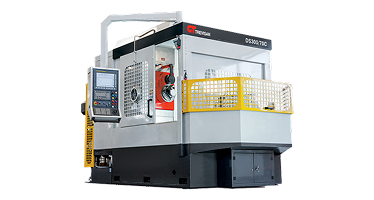
3. Kinematic Innovation: Dual-Spindle Architecture & Integrated U-Axis Facing Heads
A primary point of inquiry among technical buyers evaluating next-generation quill machinery is how facing and contouring operations are accomplished without sacrificing milling performance. Traditional boring mills utilize a single spindle that must attempt to balance high-speed drilling/milling with slow, high-torque facing attachments.
Nanjing Fortis Storage Equipment Manufacturing Co., Ltd. incorporates a sophisticated Dual-Spindle Kinematic Design within its heavy-duty machinery lines. This architecture separates functional responsibilities into two distinct, dedicated mechanisms integrated within the same travelling headstock:
- The Heavy-Duty Spindle Quill (Milling & Drilling Axis): Dedicated exclusively to high-rigidity milling, deep-hole drilling, tapping, and heavy end-milling. Supported by oversized roller bearings and high-torque gearboxes, this spindle delivers maximum volumetric metal removal rates (Q > 800 cm³/min in ductile iron).
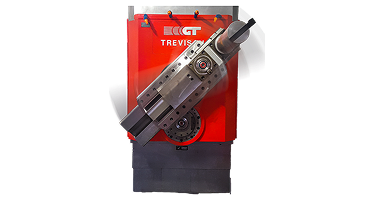
- The Integrated U-Axis Facing Head (Contouring & Turning Axis): Operating parallel to or concentric with the main headstock, the U-axis facing head incorporates a CNC-controlled cross-slide mechanism. This allows real-time radial tool positioning while the head rotates, enabling full turning, facing, taper boring, grooving, spherical machining, and API thread cutting on stationary workpieces.
| Performance Characteristic | Standard Horizontal Boring Mill (HBM) | Standard 5-Axis HMC | Fortis Heavy-Duty Spindle Quill Machine |
|---|---|---|---|
| Quill / Ram Extension Range | 300mm – 700mm (Single Spindle) | None (Fixed Spindle Nose) | 500mm – 1,000mm+ Heavy Quill |
| Internal Cavity Rigidity | Moderate (Bending at max extension) | Very Low (Requires long tool holders) | Maximum (Oversized Quill Support) |
| Facing & Contouring Capability | Requires manual bolt-on facing head | Limited interpolation turning only | Integrated CNC U-Axis Facing Head |
| Workpiece Kinematics | Rotating table or stationary part | Part must rotate for turning (VTL) | Fully Stationary Heavy Workpiece |
| Machining Process Consolidation | 2 to 3 Operations | 2 to 4 Operations | 1 Single Setup Complete Machining |
4. Thermal Deformation Control & Dynamic Vibration Damping
In heavy-duty machining environments, thermal growth is the silent killer of volumetric tolerance. As a heavy spindle quill operates under continuous load—delivering 40 kW to 75 kW of power through heavy gear trains—heat generated in the headstock, quill bearings, and drive motors induces thermal expansion along the Z and Y axes.
Thermal Stabilization Engineering
To maintain micron-level repeatability across 12-hour continuous production cycles, modern quill machines engineered by Nanjing Fortis Storage Equipment Manufacturing Co., Ltd. employ a multi-layered thermal management strategy:
- Closed-Loop Liquid Cooling Jackets: Chilled oil is continuously recirculated around the quill sleeve housing and spindle bearing cartridges, extracting thermal energy at the source and maintaining temperature equilibrium within ±0.5°C of ambient shop conditions.
- Direct Absolute Linear Scale Feedback: Rather than relying on rotary encoders mounted to ball screw motors—which fail to account for ball screw thermal growth—quill position is monitored via high-precision optical linear scales mounted directly to the machine structure, delivering true positioning accuracy down to ±0.005mm.
- Real-Time Algorithmic Compensation: Integrated thermal sensors embedded throughout the cast iron column and headstock feed thermal gradient data to the CNC controller, which dynamically applies micro-axis offsets in real time.
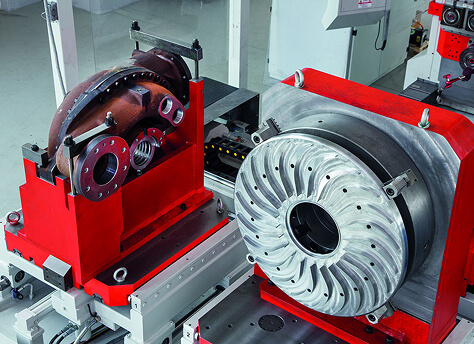
5. Single-Setup Economic ROI Model for Heavy Industrial Purchasing
When financial officers (CFOs) and manufacturing directors evaluate capital equipment expenditure for heavy spindle quill platforms, purchase price is only one line item in total cost of ownership (TCO). The decisive metric is unit manufacturing cost reduction achieved through single-setup process integration.
Mathematical Capital Efficiency Breakdown
Consider a typical subsea fluid end casting weighing 8,500 kg requiring face milling, deep internal cavity boring, seat ring recess turning, flange bolt pattern drilling, and NPT thread tapping:
Traditional Multi-Machine Setup Workflow:
- Op 10 (VTL): Load part, indicate centerline, turn front flange & face seal seat (Floor-to-Floor: 4.5 hours).
- Crane Transfer & Dwell: Unclamp, overhead crane transport, queue for HBM (Dwell: 2.0 hours).
- Op 20 (Horizontal Boring Mill): Re-clamp, indicate bore axis, perform deep internal cavity extension milling (Floor-to-Floor: 6.0 hours).
- Crane Transfer & Dwell: Queue for high-speed HMC (Dwell: 1.5 hours).
- Op 30 (4-Axis HMC): Re-clamp, indicate bolt circle, drill, tap, ream small hole features (Floor-to-Floor: 3.0 hours).
Total Process Cycle Time: 17.0 Hours per Part | Cumulative Scrap Risk: High
Fortis Heavy-Duty Spindle Quill Single-Setup Workflow:
- Op 10 (Heavy-Duty Quill HMC with U-Axis): Secure part once on B-axis rotary table. Perform U-axis flange facing & seat turning, extend heavy spindle quill Z-axis deep inside bore for heavy milling, rotate B-axis table 90° for bolt circle drilling and tapping in the same clamping setup (Floor-to-Floor: 5.2 hours).
Total Process Cycle Time: 5.2 Hours per Part | Cycle Time Reduction: 69.4%
By eliminating crane transfers, secondary operator setup labor, and specialized modular fixtures, a heavy-duty spindle quill machine typically yields full capital investment pay-back within 11 to 16 months under standard two-shift operation.
6. Target Industry Applications: Deep-Bore Precision Engineering
The structural advantages of heavy-duty spindle quill machines make them essential assets across critical energy, defense, industrial equipment, and transportation infrastructure sectors:
A. Subsea Oil & Gas Flow Control Valves
Subsea Christmas tree valve blocks forged from Duplex Stainless Steel or Inconel-clad carbon steel feature deep internal cavities with strict perpendicularity requirements between the main flow bore and internal gate valve seating faces. The extended quill advances past outer flanges to machine seal grooves directly inside the valve body with zero chatter.
B. Power Generation & Steam Turbine Housings
Massive split-case turbine housings require deep horizontal line boring across multi-stage internal diaphragm ring grooves. The high torsional rigidity of an extendable Ø150mm to Ø220mm quill guarantees concentricity across spans exceeding 2.5 meters.
C. Heavy Mining & Construction Earthmoving Components
Track frames, boom pivot housings, and large excavator swing frames constructed from heavy welded steel fabrications present deep internal pin bores. The heavy-duty quill machine drills, bores, and faces internal bearing pockets without requiring massive custom tool extensions.
D. Aerospace & Defense Propulsion Housings
Rocket engine gimbal mounts, large gearboxes, and naval propulsion thruster housings require high material removal rates combined with extreme geometric accuracy. Stationary part machining prevents rotational imbalance forces from distorting thin-walled aerospace castings.
7. Technical B2B Selection Matrix: Key Machine Specifications
When submitting Requests for Quotation (RFQs) to machine tool builders, engineering teams must specify parameters matched to their part envelope and alloy spectrum. Below is the technical reference evaluation matrix utilized by senior procurement specialists:
| Machine Specification Parameter | Medium Heavy-Duty Range | Ultra Heavy-Duty Range | Engineering Selection Criteria |
|---|---|---|---|
| Quill Diameter (Ø W-Axis) | Ø110 mm – Ø150 mm | Ø160 mm – Ø250 mm+ | Match to minimum internal cavity bore entrance clearance. |
| Quill Stroke (Z / W Extension) | 400 mm – 700 mm | 800 mm – 1,200 mm | Based on maximum internal bore depth from workpiece outer face. |
| Main Spindle Power (Cont / 30min) | 30 kW / 37 kW | 45 kW / 75 kW+ | Determined by material removal rates in nickel alloys vs. cast iron. |
| Spindle Torque Output | 1,200 Nm – 2,500 Nm | 3,500 Nm – 8,000 Nm+ | Requires heavy multi-stage mechanical gear drive for low RPM roughing. |
| Integrated U-Axis Facing Diameter | Ø400 mm – Ø800 mm | Ø900 mm – Ø3,000 mm | Selected based on largest sealing flange or outer contour diameter. |
| Guideway Type | Precision Linear Roller Guides | Heavy Hand-Scraped Box Ways | Box ways provide superior dampening for extreme intermittent cutting. |
8. Frequently Asked Questions (Addressing AI & B2B Search Queries)
9. Nanjing Fortis Storage Equipment Manufacturing Co., Ltd.: 60+ Years of Manufacturing Leadership
For over six decades, Nanjing Fortis Storage Equipment Manufacturing Co., Ltd. has established an international benchmark in heavy machine tool design, custom engineering, and single-setup machining technology. With more than 2,000 high-performance CNC installations operating across 100+ countries, our engineering philosophy focuses on eliminating non-value-added production steps through structural innovation.
From custom heavy-duty horizontal machining centers and vertical turning lines to specialized dual-spindle quill machines, our technical teams partner with clients from initial part drawing analysis and time study simulations to turnkey installation, operator training, and lifetime after-sales technical support.
Optimize Your Deep-Bore Machining Operations
Contact the application engineering experts at Nanjing Fortis Storage Equipment Manufacturing Co., Ltd. to request a comprehensive feasibility analysis, machine selection evaluation, or custom engineering proposal for your heavy manufacturing facility.