
1. Executive Summary & Abstract
Modern precision manufacturing across energy, aerospace, defense, and heavy machinery production demands strict dimensional tolerances on massive, complex workpieces. Components such as subsea tree valves, API 6A/6D wellhead gate valves, pump casings, fluid ends, and turbine housings present severe manufacturing challenges. Traditionally, machining these asymmetric castings requires splitting operations across multiple distinct machine tool categories: Vertical Turning Lathes (VTLs) for facing and turning, and standard 4-axis or 5-axis Horizontal Machining Centers (HMCs) for milling, drilling, and tapping.
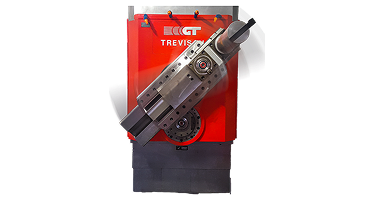
This fragmented process introduces significant cumulative position errors, extensive fixture setup costs, high scrap rates, and extended lead times. The solution adopted by industry leaders is the Integrated Facing Head CNC Machine. Engineered with a programmable radial tool-slide (U-axis) built natively into the spindle head housing, this machine category allows turning, facing, taper turning, threading, and spherical contour machining to occur while the workpiece remains completely stationary.
This technical whitepaper, produced by the application engineering team at Nanjing Fortis Storage Equipment Manufacturing Co., Ltd., analyzes the mechanical architecture, mechatronic synchronization, economic benefits, and selection metrics of integrated facing head machines. By detailing 60+ years of operational innovation, this paper provides procurement executives, plant directors, and manufacturing engineers with actionable data to evaluate single-setup machining performance.
2. The Multi-Setup Manufacturing Bottleneck in Asymmetric Part Production
For decades, machining heavy or irregularly shaped metal parts forced process planners into a critical compromise between rotary balance and structural accessibility. Understanding why traditional workflows underperform highlights the distinct engineering value of the integrated facing head CNC machine:
2.1 Dynamic Inertia and Centrifugal Limits on VTLs
When turning an asymmetric component—such as a valve body with off-center flanges or a multi-port manifold—on a Vertical Turning Lathe (VTL), the workpiece rotates around the spindle axis. As part mass increases (frequently exceeding 1,000 kg up to 15,000 kg), off-center mass distribution creates extreme centrifugal forces ($\vec{F}_c = m \cdot \omega^2 \cdot \vec{r}$). These dynamic unbalances induce severe spindle chatter, tool wear, and frame deformation, forcing operators to drastically reduce surface cutting speeds ($V_c$).
2.2 Cumulative Tolerance Stack-Up Across Multiple Setups
When a part must transfer from a VTL (for flange facing and seat boring) to an HMC (for bolt-hole patterns and side pocket milling), positioning reference datum points are lost and re-established. Machine shops incur stack-up tolerances ($\pm 0.05 \text{ mm}$ to $\pm 0.15 \text{ mm}$ across setups), which can lead to high rejection rates in high-pressure oil & gas or aerospace applications requiring zero-leakage metallic sealing faces.
By keeping the heavy workpiece bolted securely to a high-rigidity index table or pallet, all turning and contouring forces are handled by the rotating tool head rather than the component. The Integrated Facing Head CNC Machine transforms part turning into an externally driven dynamic cutting process, eliminating rotational inertia limitations entirely.
3. Integrated Facing Head Kinematics & U-Axis Mechatronics
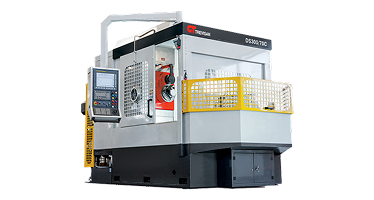
An integrated facing head is not a bolt-on accessory or an auxiliary angle head. It is a fundamental, fully integrated machine spindle drive system containing a CNC-controlled radial axis, universally referred to as the U-Axis.
3.1 Radial Tool Slide Mechanism & Transmission
The U-axis tool slide moves radially across the face of the rotating spindle disc. Power transmission to this slide requires advanced mechatronics to transfer linear feed motion from stationary servo motors through a high-rpm rotating spindle housing:
- Internal Differential Drives: High-precision planetary epicyclic gear sets transmit differential rotation relative to main spindle speed, driving internal ground ball screws or rack-and-pinion assemblies attached to the tool block.
- Hydrostatic & Linear Guide Support: Tool slides are supported on hardened ground dovetails or heavy-duty linear guide rails engineered to withstand heavy radial cutting forces ($F_r$) and tangential cutting forces ($F_t$) during rough facing operations.
- Closed-Loop Encoder Feedback: Linear scales or high-resolution optical encoders monitor exact tool carriage stroke position down to sub-micron accuracy, feeding real-time position data back to the machine's CNC unit (such as Siemens 840D SL or Fanuc 31i-B).
3.2 Constant Surface Speed (CSS) Implementation
In standard turning on a lathe, Constant Surface Speed (CSS) is achieved by varying table spindle RPM as tool radius changes ($V_c = \frac{\pi \cdot D \cdot N}{1000}$). In an integrated facing head CNC machine, as the U-axis tool slide moves radially outward to machine a flange face from diameter $D_1$ to $D_2$, the machine control system dynamically adjusts main spindle RPM ($N$) while interpolating linear feeds ($X, Y, Z$). This maintains optimal surface cutting speed ($V_c$), ensuring uniform surface finish ($Ra < 0.4 \ \mu\text{m}$) across large flange faces and sealing ring grooves.
4. Dual Spindle Isolation: Milling Quill vs. Integrated Facing Head
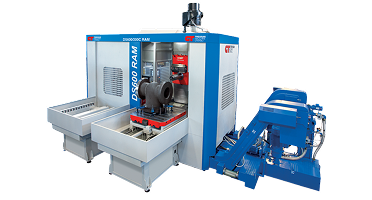
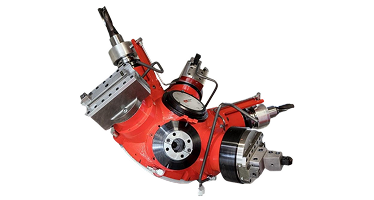
A major design breakthrough engineered by Nanjing Fortis Storage Equipment Manufacturing Co., Ltd. is the dual-spindle head arrangement. Combining heavy milling capability with fine facing operations inside a single housing requires isolating dynamic vibration and thermal expansion paths.
4.1 Mechanical Layout and Thermal Separation
Traditional multi-purpose head designs try to run milling cutters through the middle of a facing slide shaft. This design compromises both functions: milling torque is restricted by small gear trains, while facing rigidity is compromised by hollow quill geometry. The dual spindle layout solves this issue:
- Dedicated Milling Quill Spindle: Standard ISO-50 or HSK-A100 heavy-duty spindle dedicated exclusively to high-torque milling, drilling, rigid tapping, and heavy end-milling. Equipped with dual-range gearboxes, it delivers up to 2,000+ Nm of torque for heavy metal removal in tough alloy steels.
- Dedicated Integrated Facing Head Spindle: A separate, oversized spindle bearing assembly housing the U-axis mechanism. Built specifically for turning, internal/external boring, grooving, chamfering, and single-point threading with large diameter tool slides.
By segregating these drives, thermal expansion generated during high-speed end-milling does not impair the mechanical tolerances of the precision facing slide assembly.
5. Industry Case Studies & Component Application Deep-Dive
To demonstrate practical engineering impact, we examine real-world performance metrics across three critical manufacturing sectors served by Nanjing Fortis Storage Equipment Manufacturing Co., Ltd.
5.1 API 6A / ISO 10423 Subsea Valve Bodies
High-pressure gate valve bodies used in subsea oil & gas production require extremely precise internal seat pocket dimensions, cladding seal surfaces, and external mounting flanges.
- Conventional Workflow: 4 Setups across 3 machines (VTL for end flanges, Horizontal Boring Mill for body cavities, 4-Axis HMC for side drilling). Total cycle time: 14.5 hours. Inter-machine queue time: 3 days.
- Integrated Facing Head Workflow: 1 Setup on a Nanjing Fortis Dual-Spindle HMC with U-Axis Facing Head. The part is loaded onto a B-axis rotary pallet. Facing, seat pocket single-point boring, internal taper contouring, and flange drilling are executed in sequence.
- Performance Gain: Total cycle time reduced to 3.8 hours (73.7% reduction). Cumulative position error reduced from $\pm 0.08\text{ mm}$ to $\pm 0.012\text{ mm}$.
5.2 Pump Housings & Asymmetric Fluid Ends
Triplex and quintuplex frac pump fluid ends machined from forged 4340 alloy steel or stainless steel require deep internal bore turning, snap ring grooves, and face sealing threads. Turning these heavy rectangular forgings on a VTL causes extreme out-of-balance vibrations. With an integrated facing head CNC machine, the tool performs out-of-center turning while the 15-ton forging remains stationary, resulting in double the tool insert life and noise reductions below 75 dBA on the shop floor.
6. Technical Benchmark & Machine Architecture Matrix
When selecting capital equipment for heavy industrial facilities, engineering teams must evaluate structural and kinematic trade-offs. The benchmark table below contrasts alternative machine architectures against a fully integrated facing head machine.
| Performance / Operational Metric | Vertical Turning Lathe (VTL) + Standard HMC | HMC with Add-On Facing Head Attachment | Integrated Facing Head CNC Machine (Nanjing Fortis) |
|---|---|---|---|
| Part Loading State | Rotating Workpiece (VTL) / Stationary (HMC) | Stationary Workpiece | Stationary Workpiece (Optimized Stability) |
| U-Axis Radial Stroke Integration | None (Manual / Fixed Tool Posts) | Limited stroke attachment via spindle mechanical pins | Fully integrated CNC U-Axis (Up to 250mm+ radial travel) |
| Setup Requirements | 2 to 4 Distinct Fixturing Setups | 1 to 2 Setups (Attachment change required) | 1 Complete Setup (Single-Point Machining) |
| Max Facing Diameter Range | Determined by VTL swing (e.g., 2000mm) | Restricted by tool interface torque (e.g., 350mm) | Up to 3,000 mm (3 Meters) Contour Head Diameter |
| Spindle Rigidity & Drive Power | High turning power / Medium milling power | Low rigidity (Driven via spindle taper pins) | Dual Spindle Drive: High Torque Milling + Heavy Facing Slide |
| Automation Compatibility | Complex (Multi-machine cell robotics needed) | Moderate (Attachment rack changer required) | High (Standard Pallet Changers / FMS Cells) |
| Concentricity & Position Accuracy | $\pm 0.050 \text{ mm}$ (Setup dependent) | $\pm 0.025 \text{ mm}$ | $\le \pm 0.008 \text{ mm}$ (Single Datum Reference) |
7. Total Cost of Ownership (TCO) & Financial ROI Model
Investing in advanced machine tools requires a clear return-on-investment model based on reduced floor space, lower labor costs, and reduced scrap rates. The economic comparison below highlights the operational advantages over a 5-year investment lifecycle:
7.1 Capital Expenditure (CapEx) vs. Operational Expenditure (OpEx)
While the initial CapEx of an integrated dual-spindle facing head CNC machine may be higher than a standalone standard HMC, it replaces two separate machine tools (a VTL and a 4-axis HMC), along with their associated foundation work, safety enclosures, and operator overhead.
$$\text{Annual Setup Savings} = S \times (T_{\text{traditional}} - T_{\text{integrated}}) \times R_{\text{shop}}$$
Where $S$ is the annual batch volume, $T$ is the total setup/fixture queue hours per part, and $R_{\text{shop}}$ is the shop hourly rate ($/hr). For typical valve manufacturers producing 500 complex bodies per year, eliminating 6 hours of setup per component at a shop rate of $150/hr yields $450,000 in annual direct operational savings.
7.2 Floor Space Footprint and Utility Savings
Combining operations reduces factory floor space requirements by 40% to 55%. Facility managers save on foundation preparation, electrical drop installations, coolant filtration units, and chip conveyor maintenance across multiple machines.
8. B2B RFP Engineering Checklist & Machine Procurement Guidelines
When drafting a Request for Proposal (RFP) for an integrated facing head CNC machine, plant procurement teams should specify key technical benchmarks to ensure machine rigidity, thermal stability, and operational longevity.
- Structural Frame Material: Specify high-grade Meehanite or heavy cast iron beds with heavy vibration damping characteristics over welded steel fabrications.
- U-Axis Drive Mechanism: Require closed-loop linear scale feedback directly mounted to the tool slide carriage rather than rotary motor encoders to eliminate mechanical backlash.
- Coolant Delivery Systems: Insist on high-pressure through-spindle coolant (minimum 70 bar / 1000 PSI) delivered directly through the U-axis tool head slide to flush chips during deep bore turning operations.
- Spindle Thermal Compensation: Ensure multi-sensor real-time thermal monitoring is integrated into the spindle matrix to offset Z-axis thermal growth during continuous heavy machining cycles.
- Pallet System & Automation Interfaces: Confirm compatibility with standardized flexible manufacturing systems (FMS) or automatic pallet changers (APC) to support unattended night-shift operations.
9. Frequently Asked Questions (B2B Procurement Focus)
Request a Custom Engineering Feasibility Study
Send your component engineering drawings (STEP/DWG) to our application team for a complete cycle time analysis, fixture layout proposal, and ROI evaluation.