
1. Executive Summary & The B2B Manufacturing Bottleneck in Pump Fabrication
In modern process industries—spanning petrochemical refining, offshore oil production, heavy power generation, and municipal water management—the mechanical reliability of pumping machinery dictates operational uptime. Industrial pumps, particularly heavy-duty centrifugal casings, split-case volutes, multi-stage barrel pumps, and slurry housings, operate under aggressive thermal gradients, intense hydraulic pressures (exceeding 250 bar), and corrosive environments. Consequently, the manufacturing tolerances required for high-reliability pump housings have surpassed the historical capabilities of standard multi-machine manufacturing cells.
For decades, pump original equipment manufacturers (OEMs) and Tier-1 sub-contractors relied on a fragmented, multi-step production line. Typically, a heavy cast or forged pump housing was first mounted on a Vertical Turning Lathe (VTL) to establish face datum profiles and turn major bore diameters. Subsequently, the partially finished casting was unclamped, transported across the factory floor, and re-fixtured onto a standard 4-axis Horizontal Machining Center (HMC) to drill flange bolt patterns, mill internal volute passages, and tap mechanical seal ports.
Information Gain Insight: The Cost of Re-Fixturing Inaccuracies
Empirical data gathered across high-mix, low-volume pump manufacturing facilities indicates that over 68% of geometric concentricity errors and seal face runout defects originate directly from multi-setup re-clamping rather than thermal drift or cutter deflection. Re-fixturing a asymmetric 3,500 kg pump volute casting introduces compounding stack-up errors, increasing scrap rates on Super Duplex stainless steel components by up to 14%.
To overcome these cost drivers and structural quality bottlenecks, Nanjing Fortis Storage Equipment Manufacturing Co., Ltd. has re-engineered the fundamental kinematics of CNC machining for pumps. By combining over 60 years of machine tool design expertise with integrated horizontal U-axis facing heads and dual-spindle architecture, Nanjing Fortis enables full-spectrum turning, boring, milling, drilling, and tapping of complex pump housings in a single, un-broken setup. This paper presents an architectural analysis of single-setup pump machining, metallurgical cutting strategies, kinematic mechanics, and a total cost of ownership (TCO) evaluation framework for B2B engineering procurement leads.
2. Kinematic Shift: Why Stationary Part Machining Outperforms Rotating Workpiece Lathes
When machining large, geometrically asymmetrical pump casings—such as double-suction volutes or multi-stage split-case pumps—conventional turning methodologies present severe mechanical limitations. On a traditional VTL or horizontal lathe, the heavy pump casting rotates at high RPM while stationary cutting tools index into the workpiece. This approach introduces three critical failure modes:
- Centrifugal Dynamic Unbalance: Asymmetrical pump volute castings possess off-center masses. Rotating a 2,000 kg asymmetric casting at turning speeds (e.g., 300 to 600 RPM) creates immense centrifugal forces, causing spindle vibration, severe chatter, poor surface finish ($R_a > 3.2\,\mu\text{m}$), and premature insert chipping.
- Fixation Strain and Elastic Deformation: To resist centrifugal throw-out on a VTL, machine operators must apply extreme clamping pressure. On thin-walled pump housings, this force induces elastic deformation. Once unclamped after turning, the pump casing relaxes, causing out-of-roundness on precision bearing bores.
- Safety Hazards and High Power Consumption: Accelerating and decelerating heavy, off-balance iron or stainless steel castings requires massive peak energy loads and necessitates heavy blast-shield enclosure walls.
The Nanjing Fortis Solution: Stationary Part Machining. On Nanjing Fortis horizontal machining centers, the workpiece remains rigidly clamped to a high-rigidity rotary index table (B-axis), while the cutting tools execute both rotational milling and controlled dynamic contour turning. Because the pump casting remains static during turning cuts, centrifugal imbalance is completely eliminated.
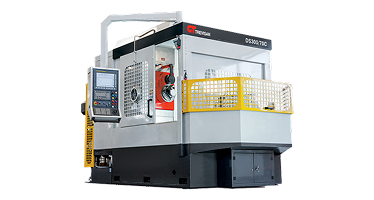
By keeping the pump housing stationary, clamping pressures can be engineered solely to resist cutting forces rather than centrifugal throw-out forces. This preserves the stress-free structural geometry of delicate pump volute walls, ensuring that bearing bores remain round to within sub-micron tolerances upon unclamping.
3. Metallurgy Strategy: Machining Super Duplex Stainless Steels and Nickel Alloys
Industrial pump components utilized in chemical processing, reverse osmosis desalination, and subsea oil recovery demand exotic corrosion-resistant alloys (CRAs). The most prominent materials in high-spec pump fabrication include Super Duplex Stainless Steel (UNS S32750 / 2507), Hastelloy C276, Inconel 625, Monel K500, and Nickel Aluminum Bronze (NAB). However, these materials exhibit high work-hardening rates, low thermal conductivity, and high abrasive carbide content, creating extreme machining challenges.
3.1 Heat Dissipation and Cutting Edge Stabilization
Austenitic-ferritic Super Duplex stainless steel rapidly work-hardens under shear stress. If a cutting insert dwells or experiences microscopic tool chatter, the surface layer strain-hardens up to 450 HV, causing catastrophic edge chipping on subsequent passes. Nanjing Fortis horizontal machining centers feature massive, heavy-duty cast iron box-way structures and pre-loaded hydrostatic/roller guide configurations that provide superior vibration damping compared to lightweight linear-way machines.
| Pump Material Grade | Tensile Strength (MPa) | Machinability Index (%) | Recommended Cutting Velocity ($V_c$) | Nanjing Fortis Machine Feature Advantage |
|---|---|---|---|---|
| Cast Iron (FC300 / GG30) | 300 | 100% | 180 – 260 m/min | High-volume stock removal with 45 kW Quill Spindle |
| Carbon Steel (A216 WCB) | 485 | 65% | 140 – 200 m/min | Dual Spindle rapid transition from roughing to finishing |
| 316L Stainless Steel | 515 | 45% | 110 – 160 m/min | High-pressure internal coolant through U-axis (70 bar) |
| Super Duplex (UNS S32750) | 750 | 25% | 45 – 70 m/min | Box-way damping prevents micro-chatter & work hardening |
| Inconel 625 / Hastelloy C | 850+ | 12% – 18% | 22 – 40 m/min | Integrated facing head variable feed-rate toolpath control |
3.2 High-Pressure Coolant Delivery & Chip Evacuation
In deep-bore pump casing operations—such as multi-stage diffuser ring bores or internal stuffing box machining—chip re-cutting poses a severe risk to tool life and surface finish. Nanjing Fortis machine tools incorporate high-pressure coolant (HPC) delivery systems (up to 70–100 bar) routed directly through the center of both the milling quill and the U-axis facing slide. This ensures direct hydraulic coolant delivery right at the cutting edge, breaking tough, stringy duplex chips into manageable segments and clearing them from deep cavities instantly.
4. Integrated U-Axis Facing Head Mechanics: Single-Setup Precision
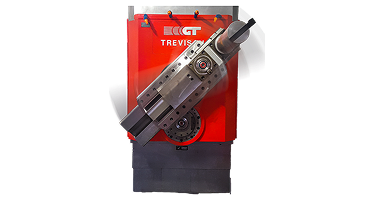
The core technological distinction of Nanjing Fortis storage equipment and machine manufacturing lies in its proprietary Integrated U-Axis Facing Head. Unlike standard horizontal machining centers that require bolt-on, program-driven facing attachments (which suffer from limited stroke, reduced rigidity, and manual tool-changer bottlenecks), Nanjing Fortis incorporates a permanently integrated, CNC-controlled U-axis facing slide built directly into the main spindle headstock.
4.1 Kinematic Dual-Spindle Mechanics
The Nanjing Fortis headstock integrates two independent, parallel operational axes on the same cast-iron slide:
- The Heavy-Duty Milling Quill (W-Axis): A high-torque, large-diameter spindle quill designed for heavy face milling, deep cavity pocketing, drilling, and rigid tapping. This spindle extends linearly along the Z/W direction to access recessed pump mounting pockets without requiring long, flexible tool extensions.
- The Servo-Controlled Facing Head (U-Axis): A rotating head carrying a radially moving tool slide driven by a dedicated, high-precision AC servo motor through a zero-backlash mechanical drive train. As the facing head rotates, the tool slide dynamically expands or contracts under CNC code control.
Engineering Breakthrough: Dynamic Contour Facing
With a fully interpolated U-axis, a Nanjing Fortis machine can execute complex turning operations on stationary pump housings—including variable-taper pump flanges, spherical valve seat recesses, complex internal radii, O-ring groove recessing, and dynamic thread cutting—all using standard single-point turning inserts. This eliminates the need for expensive custom form tools.
5. Architectural Comparison: VTL + HMC Multi-Cell vs. Nanjing Fortis Single-Setup
To evaluate the economic impact for industrial purchasing teams, we must compare the operational workflows of traditional multi-machine setups against the single-setup architecture offered by Nanjing Fortis Storage Equipment Manufacturing Co., Ltd.
| Production Metric | Traditional Workflow (VTL + 4-Axis HMC) | Nanjing Fortis U-Axis Single-Setup Machine | Procurement Impact & ROI |
|---|---|---|---|
| Machine Count Needed | 2 Machines (1 VTL + 1 HMC) | 1 Integrated Machining Center | 50% reduction in capital expenditure & floor space |
| Operators Required | 2 to 3 Skilled Operators per shift | 1 Operator per shift | Up to 60% reduction in direct labor overhead |
| Setup / Fixturing Cycles | 3 to 4 manual reclamping steps | 1 single clamp on B-axis table | Eliminates alignment re-probing & stack-up errors |
| Concentricity / Bore Alignment | 0.025 mm – 0.050 mm (clamping drift) | < 0.005 mm (single-setting datum) | Guarantees strict compliance with API 610 / ISO 13709 |
| Average Floor-to-Floor Time | 8.5 Hours (including transit & setup) | 3.8 Hours (continuous machining) | 55% reduction in total cycle time per pump housing |
By eliminating the interim transit, queue time, and alignment overhead associated with moving pump castings between machines, Nanjing Fortis equipment dramatically compresses manufacturing lead times. This allows pump manufacturers to handle custom engineering orders (ETO - Engineer to Order) with unprecedented speed.
6. Empirical Field Study: API 610 BB2 Double-Suction Pump Casing Fabrication
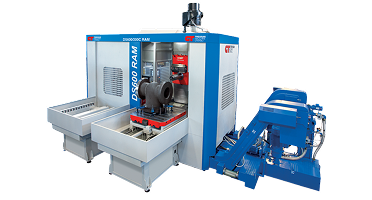
To demonstrate the real-world manufacturing performance of Nanjing Fortis equipment, consider an empirical field study conducted for a global petrochemical pump supplier manufacturing API 610 Type BB2 twin-bearing double-suction pump housings cast in Duplex Stainless Steel (ASTM A890 Grade 4A).
6.1 Challenge & Tolerance Requirements
The BB2 pump casing requires twin suction and discharge flanges with strict serrated face specifications (ASME B16.5), dual internal impeller wear ring bores, mechanical seal chamber bores, and split-line bolt patterns. Crucially, the distance between opposing wearing ring locations exceeded 1,200 mm, with a strict total indicator reading (TIR) runout limit of 0.008 mm across both bearing journals to prevent high-frequency shaft vibration during operation.
6.2 Machining Sequence on Nanjing Fortis Horizontal U-Axis Machine
- Clamping & Probe Calibration: The raw casting is loaded onto the B-axis NC rotary table. An automated touch probe measures cast datum surfaces, establishing localized coordinate frames and computing stock division automatically.
- Rough Milling & Volute Cavity Clearance: The heavy-duty milling quill (W-axis) extends with a 125 mm indexable face mill to machine top split-line faces and rough out internal volute passages at high material removal rates (MRR > 350 cm³/min).
- Opposing Flange Facing & Serration: The table indexes 90°. The U-axis integrated facing head extends. Utilizing a single-point carbide turning insert, the U-slide interpolates outward, producing perfectly flat flange faces and cutting phonographic serration grooves in continuous spiraling toolpaths.
- In-Line Precision Boring of Wear Ring Seats: Using the facing head tool-slide locked at precise radii, the spindle bores opposing wear ring seat pockets in a single pass across the indexing rotary table, maintaining total axial concentricity well within 0.004 mm.
- Flange Drilling and Port Tapping: The main milling spindle rapidly indexes through the automatic tool changer (ATC) to select carbide drills and taps, executing all flange hole patterns, seal flush ports, and drain connections in the same sequence.
6.3 Results & Quality Metrics
Using the Nanjing Fortis single-setup methodology, the customer achieved a 58% reduction in overall processing time (from 11.2 hours down to 4.7 hours per casing). CCT (Coordinate Measuring Machine) verification confirmed concentricity across dual wear ring bores at 0.0038 mm TIR, easily surpassing the API 610 requirement and achieving zero rejected castings across a 150-unit production run.
7. Quality Assurance, GD&T Control, and Precision Inspection Protocols
Achieving regulatory compliance for critical service pumps (e.g., nuclear feed pumps, offshore firewater pumps, high-pressure hydrocarbon injection pumps) requires rigorous adherence to Geometric Dimensioning and Tolerancing (GD&T) standards under ISO 1101 and ASME Y14.5.
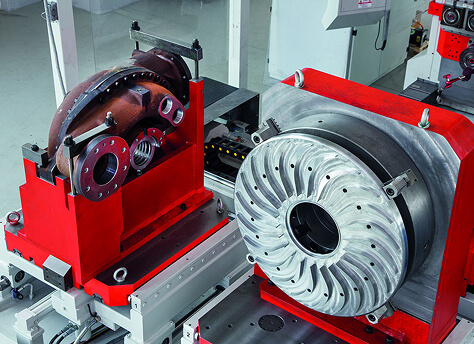
7.1 Thermal Drift Mitigation Strategy
Long machining cycles on heavy steel castings naturally generate thermal energy in spindles, axis ball-screws, and structural columns. Nanjing Fortis machine tools incorporate multi-point thermal sensors coupled with real-time CNC thermal compensation algorithms. Fluid chillers continuously circulate temperature-controlled oil through the spindle jacket and hollow-core ball screws, ensuring structural drift remains under $\pm 0.003\,\text{mm}$ across a 24-hour continuous production cycle.
7.2 In-Process Metrology & Automatic Tool Renishaw Probing
To support lights-out automated production, Nanjing Fortis machines integrate spindle-mounted wireless laser probes and tool-setting systems. The machine automatically verifies tool wear, detects broken drills, measures bored diameters, and feeds off-set adjustments directly to the CNC controller prior to taking final finishing cuts on critical bearing registers.
8. Technical Procurement Guide & ROI Assessment Framework
For procurement managers, directors of manufacturing engineering, and plant superintendents evaluating capital investments in CNC machining for pumps, capital expenditure (CapEx) must be balanced against lifetime operational expenditure (OpEx).
8.1 Key Machine Selection Parameters for Pump Component Manufacturing
- B-Axis Rotary Table Load Capacity: Ensure the rotary table can support not just the raw casting weight, but also dynamic cutting vector loads. Nanjing Fortis tables feature high-rigidity hydraulic clamping mechanisms with payload ratings exceeding 15,000 kg.
- U-Axis Stroke & Max Turning Diameter: Match facing head slide travel to your largest flange and internal chamber sizes. Nanjing Fortis U-axis heads offer contour turning capability up to 3,000 mm in diameter.
- Spindle Torque Profile: Tough materials like Inconel and Duplex require high low-end torque. Nanjing Fortis dual-spindle gearboxes deliver torque outputs exceeding 2,500 Nm, providing maximum cutting power at low RPMs.
8.2 Total Cost of Ownership (TCO) ROI Model
B2B ROI Equation
$$\text{TCO Savings} = (\Delta\text{Labor Costs} + \Delta\text{Scrap/Rework}) \times N_{\text{pumps}} - (\text{CapEx}_{\text{Fortis}} - \text{CapEx}_{\text{Multi-Machine}})$$
Because a single Nanjing Fortis machine replaces both a VTL and a standard 4-axis HMC, initial capital outlay is typically 15–25% lower than purchasing two separate high-end machines. When combined with a 50%+ reduction in direct labor and an 80% reduction in scrapped castings, typical capital pay-back periods average 14.2 months under 2-shift operations.
9. Frequently Asked Questions (FAQ) for Industrial Procurement Teams
Nanjing Fortis machines keep the pump casting stationary on a high-rigidity NC table while the cutting head rotates. Because the heavy, asymmetrical workpiece does not rotate, centrifugal unbalance and vibration are completely eliminated, allowing high cutting speeds and preserving delicate casting walls.
Yes. By performing face milling, wear ring boring, seal housing turning, and flange facing in a single setup without unclamping the part, total indicator runout (TIR) between opposing bearing journals is consistently held below 0.005 mm, comfortably exceeding API 610 and ISO 13709 standards.
Our heavy-duty box-way construction and high-torque dual spindles are specifically engineered for difficult-to-machine metals, including Super Duplex (UNS S32750/S32760), Hastelloy C276, Inconel 625, Monel, Nickel Aluminum Bronze (NAB), Titanium, and standard Cast Steel/Grey Iron.
Traditional facing attachments are auxiliary add-ons with limited travel stroke, lower rigidity, and manual setup requirements. The Nanjing Fortis U-axis facing head is fully integrated directly into the headstock housing with a dedicated CNC servo drive, enabling continuous contouring, dynamic taper turning, thread chasing, and heavy facing up to 3,000 mm diameter fully automatically.
You can submit your CAD drawings (.STEP / .IGES) and production requirements directly to our technical engineering team at [email protected]. We provide comprehensive time studies, tooling layouts, and kinematic simulation reports for your evaluation.
Transform Your Pump Manufacturing Efficiency Today
Contact our senior machining architects for a tailored technical proposal, cycle time study, or custom fixture engineering plan.